The Satanic Verses episode
The Satanic VersesThe Satanic Verses episode is a turning point in Mahound’s struggle to establish his message in Jahilia: a bargain with the city’s ruler leads to a public recitation that seems to accommodate its goddesses, followed by a forceful repudiation. The event brings political recognition and religious authority into direct conflict, but its account unsettles any easy distinction between divine revelation and its counterfeit. Gibreel Farishta, the visionary witness, claims that the same voice produced both the verses and their reversal.
Background and the proposed bargain
Jahilia is a city whose religious and commercial life has become entangled with exploitation and spectacle. Its rulers have encouraged licentious entertainments, while the House of the Black Stone draws pilgrims and money. Gatekeepers have extorted travelers, and members of the Shark tribe have gone so far as to push two pilgrims down the sanctuary’s stairs after receiving what they considered an inadequate payment. The violence discouraged return visits; female pilgrims are also described as vulnerable to kidnapping or sale. Against this setting of competing interests, Mahound’s insistence on one God sounds not only theologically disruptive but politically dangerous.
Abu Simbel proposes a test that he presents as a fair contest. He asks Mahound to recognize Lat, Uzza, and Manat as worthy of worship, although they are three among the 360 idols in the House. In exchange, Abu Simbel promises that Mahound’s followers will be tolerated and officially recognized, and that Mahound will receive a seat on the Council of Jahilia. The offer turns a religious claim into a public negotiation: recognition could protect the new movement, but the price would appear to compromise its central confession.
When Mahound returns to the well where his followers are washing, he tells them he has received an offer. Khalid immediately urges him to refuse, while Bilal expresses confidence in the Messenger. Hamza cautions Bilal that faith belongs to God, not to a human messenger, and warns the group not to show Mahound their fear. Salman the Persian identifies the proposal as a trap from either direction: accepting would invite the accusation that Mahound had arranged a convenient revelation, while abandoning the movement’s creed would make its adherents appear inconsistent and powerless. Mahound replies that he has learned to listen, and describes revelation as an inward experience that seems to arise from the deepest part of himself. His account establishes the episode’s central uncertainty before the public recitation begins.
The public recitation
Mahound’s inward struggle is represented through his unusual state of listening. In the cave on Mount Cone, Gibreel hovers above him, yet the boundary between witness and speaker becomes indistinct: Gibreel feels himself inside Mahound, joined to him by a luminous, umbilical connection, and cannot tell which is dreaming the other. Mahound’s doubts include whether the goddesses might be angels, whether he is tempted by vanity and political advantage, and whether the proposed concession could help save souls. He also recalls that the burden of prayer was reduced from forty daily prayers to five after Moses urged him to ask for relief. Still, Gibreel offers no answer to Mahound’s questions.
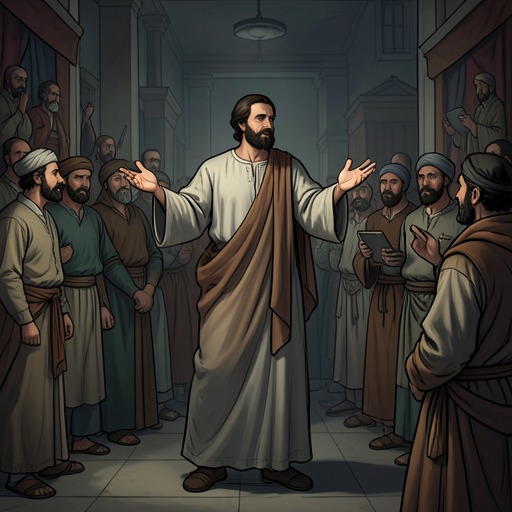
At a poetry gathering, Mahound arrives with his followers to an audience initially inclined to mock him. He walks to the stage with his eyes shut, while scribes press forward to record what he says. Abu Simbel publicly welcomes him as a seer and kahin, changing the crowd’s reception and making space for Mahound to speak. Mahound presents himself not as a poet but as a messenger carrying verses from a greater source. The gathered poets and spectators, among them Baal, listen as he begins his recitation.
After first reciting verses that affirm his vision, Mahound speaks of Lat, Uzza, and Manat as exalted beings whose intercession is desired. The effect is immediate and public. Hind rises; Abu Simbel stands upright, then raises his hands and proclaims a formula of praise before kneeling. Hind follows. The crowd, including people outside the tent, kneels in rows, the movement spreading outward from Abu Simbel and Hind. The scene appears to turn a private bargain into a collective act of worship, with the city’s ruler and his wife visibly validating Mahound’s words.
Khalid, watching from the tent entrance, is horrified. As the crowd kneels before the Prophet, Mahound remains standing and motionless. Khalid flees into the city. The outward signs of acceptance therefore do not settle the question of what has happened: the crowd responds as if a religious reconciliation has occurred, but Mahound does not join its devotion, and the account has already shown him struggling over the meaning and source of the words.
Repudiation and immediate aftermath
After a further encounter represented as a wrestling match between Mahound and Gibreel, Mahound wakes in the wilderness. He concludes that the figure he believed to be the archangel was the Devil in disguise, and that the verses recited at the poetry gathering were satanic rather than divine. He returns to Jahilia urgently, intent on removing them from the record. The narrative makes this recognition decisive for Mahound, while preserving a contradiction that prevents it from becoming a straightforward explanation of the event.
Mahound goes to the House of the Black Stone and announces that the verses have been abrogated and banished from the true recitation. In their place, he recites verses denying that the goddesses possess authority granted by Allah. He leaves the sanctuary before anyone in the stunned crowd can throw the first stone. The public reversal undoes the apparent accommodation: the words that seemed to recognize the goddesses are now rejected, and Mahound again asserts the uncompromising distinction between Allah and the idols.
Mahound returns home after the repudiation and finds his elderly wife dead beside a stone-latticed window. The narration presents her death as a form of punishment or vengeance, but does not resolve whose vengeance it is or establish a simple causal explanation. Its placement after the public crisis gives the reversal a private cost without clarifying whether that cost belongs to divine judgment, hostile human action, or the ambiguous forces that shape the episode.
Conflicting accounts and textual authority
Gibreel’s account destabilizes Mahound’s explanation of the revelation. Gibreel says that he was present on both occasions: the voice behind the initial verses and the voice behind their repudiation came from him. Thus Mahound’s certainty that the first revelation was satanic does not match the account’s claim about who spoke. The distinction between angel and Devil, or between authentic verse and its counterfeit, cannot be verified by the scene’s human participants; the reader encounters competing interpretations rather than an uncontested transcript.
The episode acquires another dimension through Salman the Persian’s later recollection. In a dream, Salman sees Mahound at the cave from a viewpoint he associates with Gibreel, and remembers the earlier controversy. He wonders whether that perspective might instead have been Shaitan’s. The dream prompts him to alter the verses he records for Mahound, first making a small substitution and later changing a reference to Christians into one to Jews. Mahound accepts these changes without noticing them at first. Salman’s account does not establish what happened in the earlier episode, but it shows how the uncertainty around revelation becomes a practical crisis of transcription: words pass through a listener, a speaker, and a scribe, and the distinctions among them prove vulnerable.
The novel’s acknowledgments further identify its Quranic quotations as composites drawn from published English versions, with some additional touches. That note concerns the book’s construction, not a historical verdict on the episode. Within the story, the recitation, its recording, and its retraction make authorship and authority inseparable questions. The episode’s force lies in its double movement: a politically advantageous verse is spoken before a crowd, then declared false, while the witness who appears to explain the reversal also claims responsibility for both voices.